


The 2026 Federal Budget – Key Proposals and What They Mean for You
2026 Federal Budget - what changed, what it means for you, and what's worth reviewing.

How could the proposals impact you and your finances?
12 May 2026
Note: Many of these measures are proposals only and may change before becoming law (unless stated otherwise). A financial adviser can help explain what may be relevant in each situation.
This year’s Federal Budget includes a mix of measures that impact tax, housing, investments and everyday costs. While some changes may create opportunities, others may mean it’s worth reviewing existing plans and strategies.
This overview is designed to help highlight some of the key measures that may be relevant across different stages of life. Your financial adviser can help you understand what these changes may mean for you, which measures are most relevant to your circumstances, and whether any action is worth considering. Some of the key measures include:
- tax cuts and other changes that may affect your overall tax position
- property and investment changes that may influence long-term wealth strategies, and
- aged and home care changes for older Australians and their families.
There were no major changes announced to superannuation. As you read through, the tags can help you quickly spot the measures that may be most relevant to you.
BILL PAYERS | CARE RECEIVERS | COMPANIES | EMPLOYEES | FAMILIES | GOVERNMENT PAYMENTS | INVESTORS | LOW-INCOME EARNERS | RETIREES | SELF-EMPLOYED | SMALL BUSINESSES | TAXPAYERS
| TRUST BENEFICIARIES
Taxation

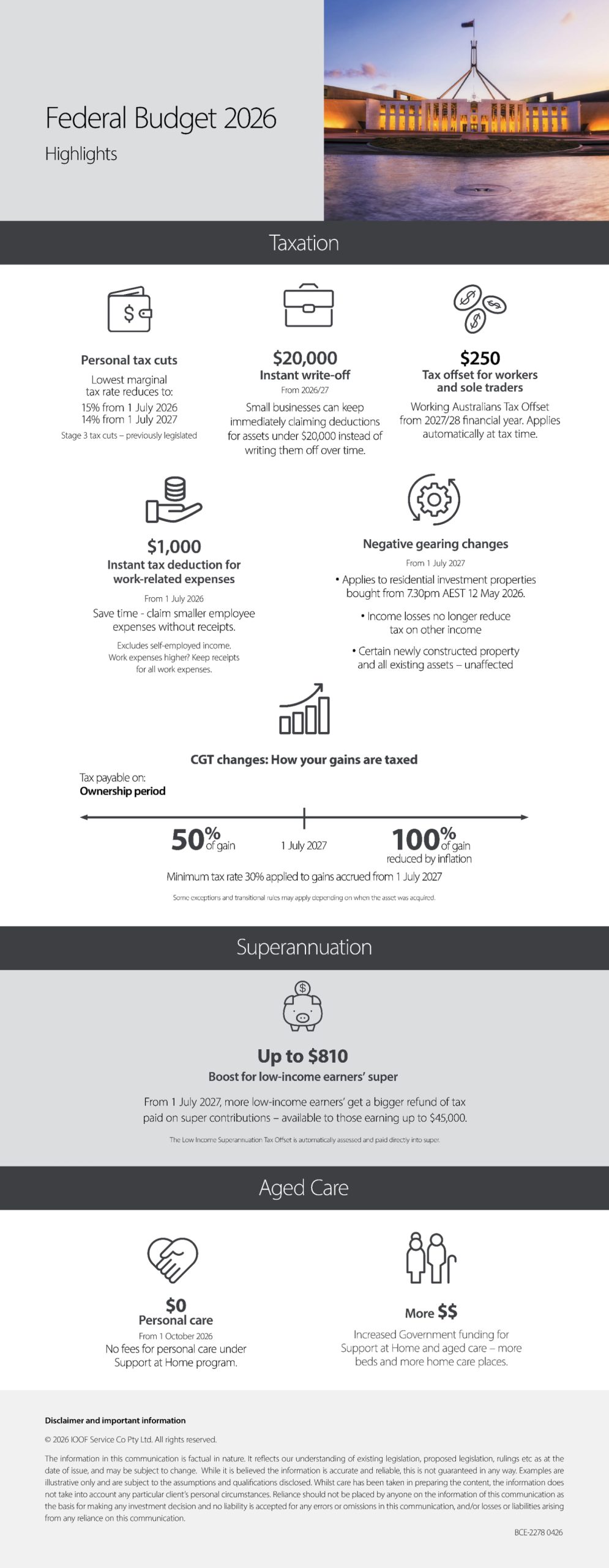
$1,000 instant tax deduction for work-related expenses
EMPLOYEES | TAXPAYERS
From the 2026/27 income year, employees will be able to claim a standard tax deduction of up to $1,000 for eligible work-related expenses, without the need to itemise individual deductions below that amount. If work-related expenses exceed $1,000, then the actual value of work expenses can be claimed, with records to support the full amount. The deduction will only be available to Australian tax residents and doesn’t apply to self-employed people or to expenses relating to investment income.
What to takeaway
Tax time could be simpler for small claims. However, keeping receipts can still be worthwhile, especially if you’re not exactly sure what your total work expenses will be, or if you think you’ll spend more than $1,000 and want the option to claim actual expenses instead. This provides the choice at the time you are completing your tax return. Also, some work-related expenses, such as donations, union and professional association fees can be claimed in addition to the $1,000 instant deduction.
Working Australians Tax Offset
EMPLOYEES | TAXPAYERS
From the 2027/28 financial year, people who earn income from work will receive a new ongoing tax offset of up to $250 a year. It applies to work-related income such as wages and salary and, where eligible, business income from sole trader activities. The offset is intended to leave a little more after-tax income in workers’ hands each year. This is in addition to the modest tax cuts from 1 July 2026 for all taxpayers.
The tax cuts are already law and were reaffirmed in the Budget. The lowest marginal tax rate (MTR) of 16% on taxable income between $18,201 and $45,000 will reduce to 15% from 1 July 2026, and 14% from 1 July 2027. There will be no changes to the other MTRs and thresholds.
What to takeaway
This is a small but ongoing annual tax saving for people earning income from work. It is expected to apply automatically through the tax return process from the 2027/28 financial year. In simple terms, it increases the amount of work income you can earn before paying tax, although the exact benefit will depend on your circumstances and whether other offsets also apply.
Medicare levy low-income thresholds increased
LOW-INCOME EARNERS | FAMILIES | RETIREES | TAXPAYERS
For the 2025/26 financial year, the Medicare levy low-income thresholds will increase by 2.9% for singles, families, seniors and pensioners. This means more low-income individuals and families may continue to pay no Medicare levy, or pay a reduced amount, which may help with cost-of-living pressures.
What to takeaway
If your income is around the Medicare levy threshold, this change may slightly reduce the tax you pay this financial year. This may be particularly relevant for lower-income households, retirees and pensioners. The exact impact will depend on your taxable income and family situation.
Private health insurance rebate changes
RETIREES | FAMILIES | TAXPAYERS
From 1 April 2027, older Australians will no longer receive a higher private health insurance rebate purely because of age. Instead, the same base rebate scale will apply across age groups, with income tiers still determining how much rebate is available. For some people aged 65 and over, this will mean higher net premium costs.
What to takeaway
If you’re 65 or older, check your current rebate tier on your latest health insurance statement or premium notice. At renewal time, confirm your details with your insurer and consider whether your cover still suits your needs and budget. If you’re considering cancelling your cover, it’s important to understand the longer-term implications. In some cases, taking out private health insurance again in the future could result in a Lifetime Health Cover loading which increases premiums. Changes to cover may also affect the types of policies or benefits available when you return, so it’s worth considering both short-term savings and longer-term costs.
Electric vehicles (EVs) – FBT concession scaled back
EMPLOYEES | TAXPAYERS
From 1 April 2027, the tax concession for eligible electric vehicles provided through work arrangements, including novated leases, will start to reduce for more expensive vehicles. In general, an existing arrangement keeps the discount rate that applied when it began.
At the moment, eligible EVs priced at or below the fuel-efficient luxury car tax threshold can access a full FBT exemption.
- Until 31 March 2027, eligible EVs up to and including the fuel-efficient luxury car tax threshold can continue to access a full FBT exemption.
- From 1 April 2027 to 31 March 2029, the full exemption remains only for eligible EVs costing $75,000 or less. Eligible EVs above $75,000 and up to the fuel-efficient luxury car tax threshold receive a 25% FBT discount instead.
- From 1 April 2029 onwards, eligible EVs up to the fuel-efficient luxury car tax threshold receive a 25% FBT discount.
What to takeaway
If you’re considering an EV through salary packaging or novated leasing, ask your provider for a cost comparison before and after the change dates. Also check whether the vehicle you’re looking at is eligible (for example, battery electric or hydrogen fuel cell vehicles), noting plug-in hybrids generally ceased being eligible from 1 April 2025 (unless transitional rules apply).
Existing arrangements typically retain the discount rate that applied when they started, but a new arrangement may be subject to the rules in place at that time. It is not yet clear whether an existing arrangement keeps its current treatment if the lease is moved to a new provider or renewed when the current lease ends.

Negative gearing changes
INVESTORS | TAXPAYERS
From 1 July 2027, income losses from established residential investment properties bought from 7:30pm AEST on 12 May 2026 can no longer be used to reduce other sources of income. Instead, those losses can only be used against residential property rent or residential property capital gains, with any unused amount carried forward for later years.
Properties already held before that time, as well as certain newly constructed residential properties are exempt. These changes apply to properties owned individually, or through partnerships, companies and most trusts, but excludes super funds.
What to takeaway
Negative gearing is where the costs of owning an investment property, such as loan interest and other expenses and deductions, are higher than the rent it brings in. Existing holdings and eligible new builds continue to receive the current treatment. An eligible new build generally means a property that genuinely adds to housing supply, such as a newly built dwelling on vacant land or a development that increases the number of homes.
Changes to capital gains tax (CGT) concessions
INVESTORS | TAXPAYERS
From 1 July 2027, a 30% minimum tax rate will apply to capital gains. People receiving income support payments, including the Age Pension, will not be subject to that minimum tax.
There are also changes to the way that CGT is calculated. This applies to all assets, not just property. The 50% CGT discount for assets held longer than 12 months will no longer apply. Taxable gains related to the period that the asset is owned from 1 July 2027 will be worked out using the indexation approach. Under the indexation approach, the original purchase price is adjusted for inflation before tax is calculated. This means tax generally applies to the gain above inflation, rather than simply applying a flat 50% discount to the whole gain.
These rules apply to investments held by individuals, trusts and partnerships. However, investors in eligible new residential properties can still choose between the 50% CGT discount and the alternative method using indexation subject to the minimum tax.
There is no change to the CGT main residence exemption or to the existing small business CGT concessions.
What to takeaway
If you own investments, such as property, shares or other assets that may qualify for the CGT discount, the way future capital gains are taxed changes from 1 July 2027. The impact will vary depending on how long the asset is held, how much it grows and inflation over that period. Existing investments retain the current treatment for gains that arose before 1 July 2027.
30% minimum tax on discretionary trusts
TRUST BENEFICIARIES | FAMILIES | SMALL BUSINESSES | INVESTORS | TAXPAYERS
From 1 July 2028, discretionary trusts will pay at least 30% tax on trust income. In simple terms, this may reduce the tax benefit of distributing income to family members who pay tax at lower rates. Not every trust or every type of income is covered, and there will also be a three-year
window from 1 July 2027 for people who want to move out of a discretionary trust structure.
What to takeaway
If you use a family trust, this change could mean less flexibility in sharing income across family members to reduce tax. Whether it affects you will depend on how your trust is set up, who receives income and the type of income involved. If this may apply to you, it could be worth getting advice early to consider the benefits of the trust structure for your circumstances or whether changing the structure is something you may want to consider.
Instant asset write-off threshold permanently increased
SMALL BUSINESSES | SELF-EMPLOYED
From 1 July 2026, the instant asset write-off threshold will be permanently increased to $20,000. The temporary higher threshold was due to return to the standard $1,000 limit next financial year. This means that eligible small businesses with an aggregated turnover under $10 million will be able to immediately deduct the cost of eligible assets costing less than $20,000 each, rather than doing so over a number of years.
Superannuation
LISTO expanded (already legislated)
LOW-INCOME EARNERS | TAXPAYERS
From 1 July 2027, the Low Income Superannuation Tax Offset (LISTO) will be expanded by increasing the income eligibility threshold from $37,000 to $45,000 and increasing the maximum payment from $500 to $810.
LISTO is designed to ensure that low-income earners still receive a tax benefit from contributing to super, by refunding the 15% contributions tax on eligible concessional contributions (such as employer super contributions). The payment is made by the ATO directly into an eligible person’s super account and is worked out automatically once a tax return is lodged.
What to takeaway
To avoid missing out, make sure your super fund has your tax file number and you lodge your tax return so the ATO can assess eligibility.
Government support
Pension Supplement changes for people overseas
GOVERNMENT PAYMENTS | RETIREES
The rules for the Pension Supplement will change for people who are overseas. The maximum Pension Supplement will continue for up to 12 weeks when a person is temporarily overseas, instead of 6 weeks. After 12 weeks overseas, or if the move is permanent, the Pension Supplement will stop. Currently, the maximum fortnightly rates are $86.50 for singles and $65.20 each for couples. It is an extra payment to assist with utility, phone, internet and medicine costs.
What to takeaway
If you receive the Pension Supplement and are planning to travel or live overseas, it may be worth considering how long you expect to be away. A short trip may now have less impact, but longer absences or moving overseas permanently could reduce your payments.
NDIS changes
GOVERNMENT PAYMENTS | CARE RECEIVERS | FAMILIES
From April 2026, the Government has announced a package of NDIS reforms aimed at improving long-term sustainability, tightening system integrity and refocusing support on people with permanent and significant disability. The changes are expected to include:
- stronger fraud controls
- tighter provider oversight
- more consistent eligibility and functional capacity assessments
- changes to what is considered reasonable and necessary support, and
- new planning and budget approaches over time.
What to takeaway
For current participants, these changes are mostly about how the system is run rather than an immediate loss of essential day-to-day support. However, over time there may be tighter checks around plans, reassessments, providers and the types of supports funded. For people seeking access in future, eligibility is expected to focus more clearly on substantially reduced functional capacity. Some changes are expected to begin from 1 October 2026, with broader planning and access reforms staged from 2027 and 2028.
Aged care and home care
Changes to Support at Home
GOVERNMENT PAYMENTS | CARE RECEIVERS | FAMILIES
More funding will be provided for Support at Home, meaning more packages will be released, expanding support to more Australians.
From 1 October 2026, Support at Home recipients approved for personal care can access these services without out-of-pocket costs. Personal care (which includes assistance with showering, dressing and non-clinical continence management), will be reclassified into the fully Government funded ‘clinical support’ category.
The table below shows the typical co-payment percentage (the share of the provider’s price paid by the person receiving support). The Government pays the remaining cost.
| Income support status | Clinical support | Independence support | Everyday living support |
| Full Age Pension (excluding Blind Pensioners) | 0% | 5% | 17.5% |
| Part Age Pension or Commonwealth Seniors Health Card | 0% | 5%–50%* | 17.5%–80%* |
| Self-funded (not eligible for Commonwealth Seniors Health Card) | 0% | 50% | 80% |
* The exact percentage within these ranges depends on income and assets.
What to takeaway
If you receive personal care services now, you will continue to make a co-payment. However, your out-of-pocket expenses for Support at Home may change from 1 October 2026.
Additional residential care funding
GOVERNMENT PAYMENTS | CARE RECEIVERS | RETIREES | FAMILIES
From 1 July 2026, additional Government funding will be provided for residential aged care services. The support includes funding to expand the number of residential care beds available, and subsidies that will be paid directly by the Government to eligible service providers. The changes are to encourage residential care providers to undertake refurbishments and enhancements of facilities, and to incentivise providers to increase the number of beds that are occupied by residents who are of low-means.
Where to from here?
Many of these measures still need to be passed into law before they take effect. In some cases, the final detail (including eligibility, thresholds and start dates) may change. Your financial adviser can help you understand what’s relevant to your situation and what actions (if any) are worth considering.
| Any questions?If you have any questions, please speak with your financial adviser who can help you to understand how these proposed changes could apply to you. |
Related Insights
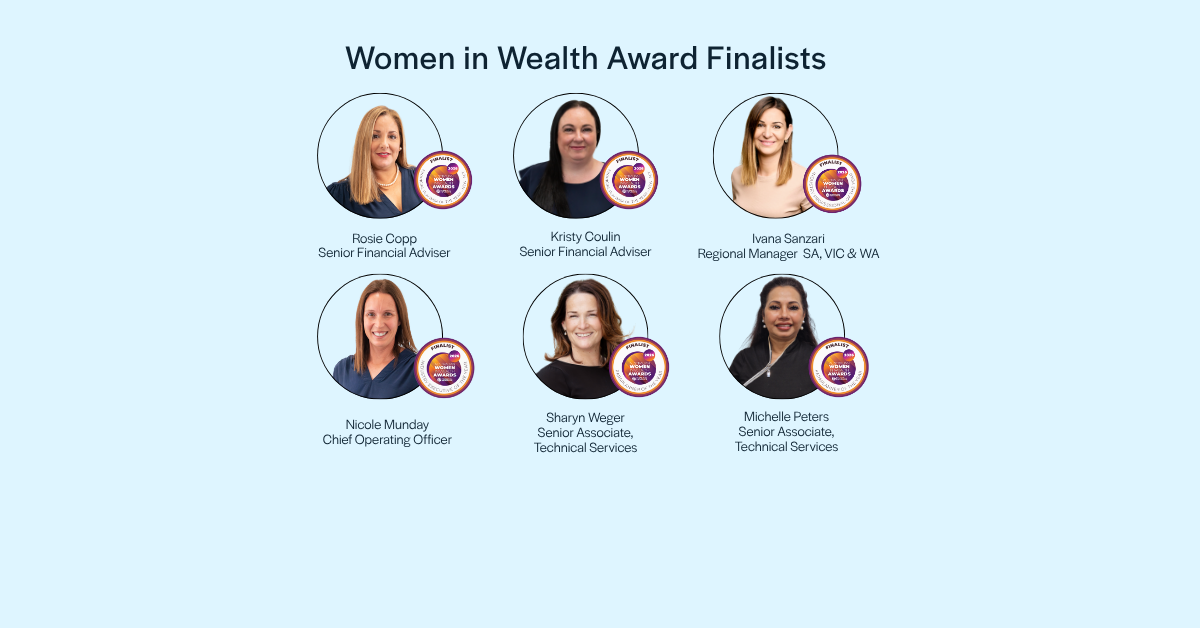
Celebrating Excellence: Our Women in Wealth Award Finalists

Understanding Volatility – Your Emotions Matter!

Why You Shouldn’t Wait: The Hidden Costs of Delaying Your Divorce Property Settlement

Turning Bricks into Building Blocks: Smarter Money Moves for the Years That Matter Most.
Celebrating Excellence: Our Women in Wealth Award Finalists
Understanding Volatility – Your Emotions Matter!
Why You Shouldn’t Wait: The Hidden Costs of Delaying Your Divorce Property Settlement


